Affiliate disclosure: WoodShopMachines.com may earn from qualifying purchases through Amazon Associates and eBay Partner Network at no extra cost to you. Product links are shopping paths, not evidence that a larger or more expensive machine is automatically the right choice.
What each tool does
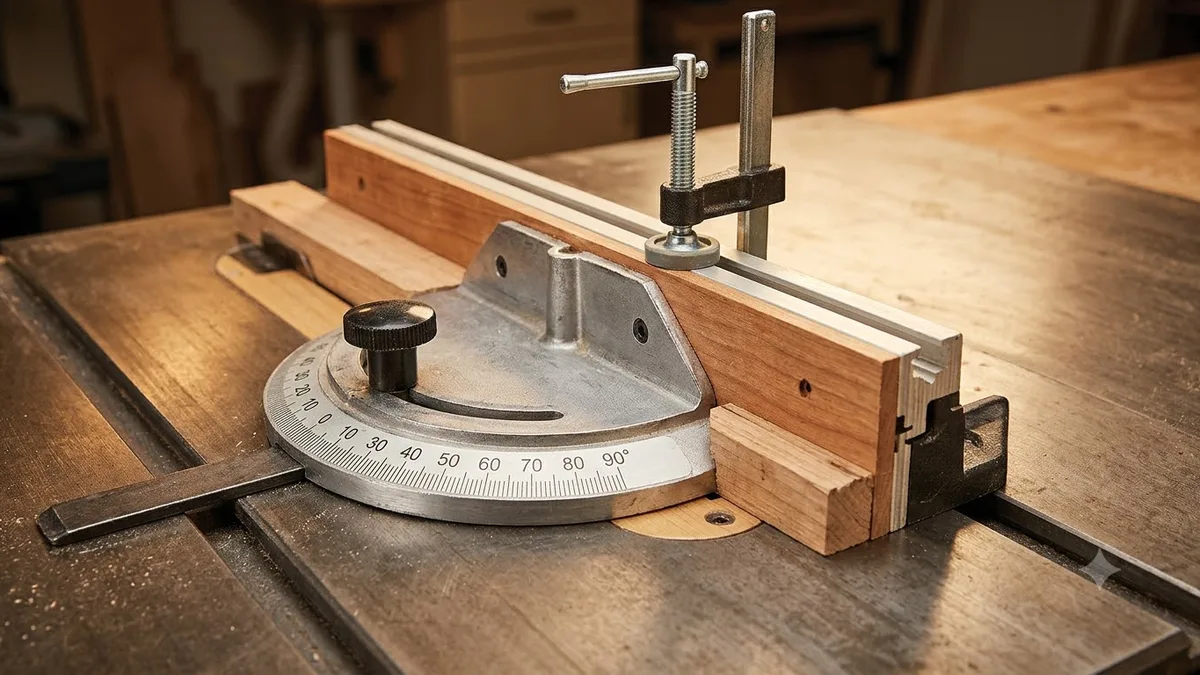
A miter gauge slides in a slot milled in the saw table. The slots run front to back, parallel to the blade, as a general reference on table saws explains. The gauge has a head that holds a fence at an angle to the blade. It is usually set at a right angle for a square crosscut, and it can be set to other angles for miter cuts.
A crosscut sled is a platform or carrier that runs on one or two runners in the miter slots. The reference describes it as holding the workpiece at a fixed 90-degree angle to the blade, which allows precise, repeatable cuts at the most common angle. It adds that sleds are usually shop-made, though they can be purchased. The board rests on the sled, which has a fence and, usually, a back guard to keep hands away from the blade.
Both depend on the miter slots. If the slots are worn or off-parallel, neither tool will cut square for long. The site's miter gauges page covers the parts, and the used table saw inspection guide covers slots and tables on second-hand saws.
Accuracy and repeatability
The sled usually wins for accuracy. The workpiece sits on the sled, the sled fence is fixed square to the blade and the runner fits the slot, so each cut is made the same way. A miter gauge has a small head and a short fence, and the head swings on a pivot. Any slop in the gauge bar, a loose lock or a small fence face adds error.
Gauges can be improved. An auxiliary fence screwed to the gauge head gives the board more support and lets you add a stop. Better gauges have tighter bars, positive stops at common angles and long fences. If you rely on a gauge for accuracy, check it for square regularly and keep a test cut for comparison. The reference above mentions the gauge is usually set at 90 degrees for a right-angle cut, so make that stop trustworthy.
A sled is only as square as its build. Because it is usually shop-made, its squareness is your responsibility, and a sled that was once square can drift as wood moves. Check it with a square or a five-cut test, then adjust or rebuild. A sled is also dedicated to one saw and one slot spacing, so it is not a tool you can lend to a friend.
Aftermarket miter gauge
Compare the bar size with your saw's miter slot width, which you can measure or find in the manual. Look for a long fence, a tight bar and positive stops. Used gauges appear on eBay; check the bar for wear.
Support for wide boards and panels
This is where the two diverge. A miter gauge supports the board only along its short fence, and a wide board or sheet overhangs and can tip. A sled supports the full board on its deck, so wide panels, large cabinet parts and awkward shapes can be crosscut with much better control. That is the main reason cabinet makers use sleds.
For a miter gauge, extend the fence and add support at the side or behind the saw so the board remains level. Boards that are too long or wide for either tool belong on a different machine. The site's sliding table saws guide covers saws that have the sliding table built in, which the reference describes as a European-style design used mainly in production cabinet shops.
Capacity depends on the saw and the sled design. Your saw's table size, the sled's width and the blade projection set what fits, and the table saw size guide shows how saws are classed. No dimensions are quoted here because they vary.
Safety: the rules that apply to both
A university wood lab's operating sheet for its table saws makes several points that match manufacturer advice. It says the machined face of the workpiece should go against the table and fence or miter gauge, that the miter gauge must be firmly attached, and that you should never use the miter gauge and rip fence at the same time. The usual concern is a cutoff trapped between the blade and the fence. If you need repeated lengths, clamp a spacer block to the fence ahead of the blade so the piece is not trapped, as the sheet describes, or use a stop on the miter gauge or sled.
The same sheet says to stand to either side of the blade, never directly behind it, to push stock fully past the back of the blade and never to back it off while the blade is running, and to confirm the guard, splitter and kickback devices work before cutting. The table saw page on Wikipedia describes kickback as a piece pinching the blade or turning against it, thrown back toward the operator, with riving knives, push sticks and covers reducing the risk.
For sleds, add the following. Your saw manual may say how a sled should be used with the guard and riving knife. Do not build or use a sled that needs the guard or knife removed unless the manual says it is acceptable. Keep your hands behind the sled's fence, and use a back guard so the blade is covered once it passes through. See table saw safety and push sticks and push blocks for the wider checklist.
Table saw crosscut sled kit or hardware
Check the runner size against your miter slots and whether the kit includes a fence and back guard. Hardware kits let you build the sled to fit your saw. Used sleds are a fit risk, so measure your slots first.
Which one to use when
| Job | Better choice | Check |
|---|---|---|
| Quick cut of a short, narrow board | Miter gauge | Gauge square, board supported |
| Square cuts on wide panels or cabinet parts | Sled | Sled square, back guard |
| Many identical lengths | Sled with stop, or gauge with stop | Cutoff not trapped |
| Angled miters | Miter gauge or a dedicated miter sled | Angle set from a reliable reference |
| Small parts that are hard to hold | Sled with hold-down | Hands kept clear |
If you are cutting with a blade that is new to the saw, check the thin-kerf vs full-kerf blade guide for the fit of the riving knife, and if your fence has been unreliable, table saw rip fence not square helps you fix it before blaming the miter gauge. A sensible path is a better gauge first, then a sled as your work grows.
Frequently asked questions
Is a crosscut sled more accurate than a miter gauge?
Usually, because the board sits on a fixed fence at a set angle and the runner fits the slot. Accuracy still depends on how square the sled is built and checked.
Can I use the rip fence with a miter gauge?
A university wood lab sheet says never to use them together as a stop, since the cutoff can be trapped. Use a spacer block clamped ahead of the blade or a stop on the gauge or sled.
Do I need a sled if I have a good miter gauge?
Not always. A good gauge handles short crosscuts. A sled helps with wide boards and repeatable square cuts.
Can I buy a crosscut sled?
Yes. A general reference says sleds are usually shop-made but can be purchased. Check that the runners fit your miter slots.
Does a sled change how I use the guard or riving knife?
It can. Follow your saw manual, and do not use a sled design that needs the guard or knife removed unless the manual allows it.
Sources and verification
- Wikipedia: Table saw (a general reference), for the descriptions of the miter gauge, the crosscut sled, the sliding table and kickback.
- Table Saw Safety and Operation, a university wood lab's operating sheet, for the rules on securing the miter gauge, not using the miter gauge and fence together, avoiding trapped cutoffs, standing to the side and pushing stock fully past the blade.
No slot widths, runner sizes, sled dimensions or cutting capacities are quoted. A university lab sheet is one workplace's rules, not a standard, so read your own saw's manual for guard, riving knife and sled instructions.