Affiliate disclosure: WoodShopMachines.com may earn from qualifying purchases through Amazon Associates and eBay Partner Network at no extra cost to you. Product links are shopping paths, not evidence that a larger or more expensive machine is automatically the right choice.
How each machine removes wood
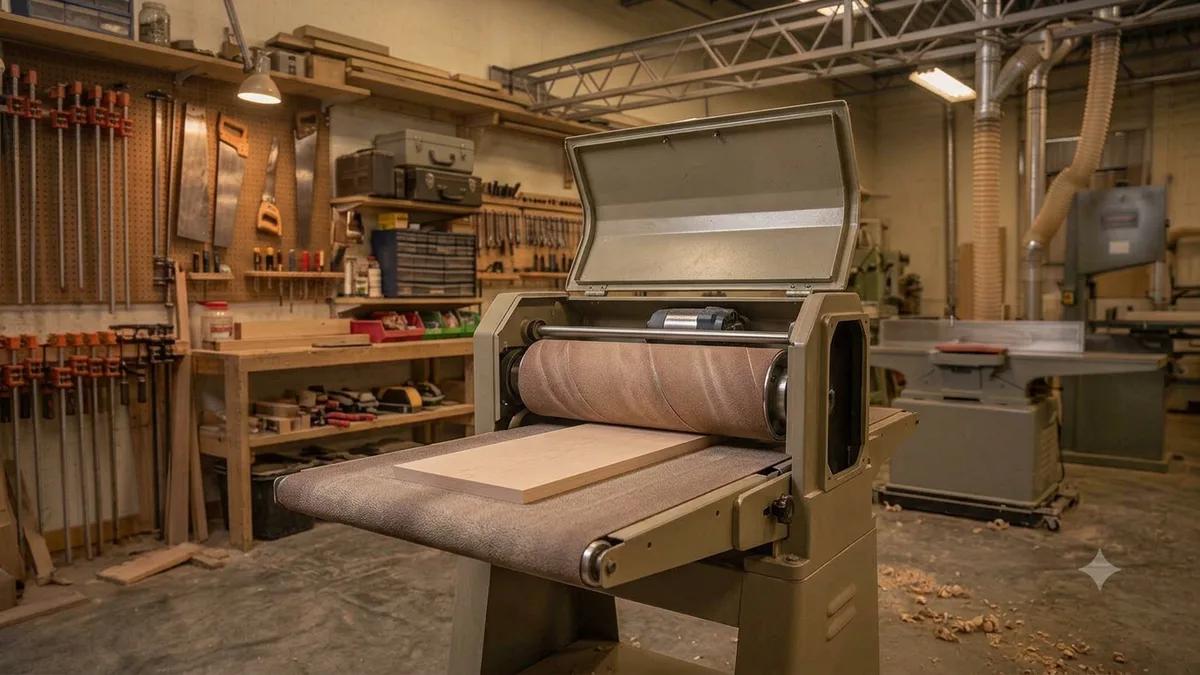
A thickness planer shaves wood with knives or inserts on a rotating cutterhead. The board is pulled through by feed rollers and the cutterhead takes a cut, so it can bring a rough board down to thickness in a few passes. A general reference page on sanders describes a drum sander as a large sander with a rotating sanding drum, fed with rollers in a planer-like way, and notes that the tabletop version sets depth by changing the grit rather than by a heavy cut.
That last difference is the whole story. The planer cuts with an edge, while the drum sander wears the surface away with abrasive. A knife can lift or tear fibers when grain changes direction. Abrasive does its work with many tiny cutting points, which generally spreads the force. The cost is speed: sanding takes off wood slowly, so a drum sander is a finishing and calibrating tool, not a way to remove a lot of stock.
Planers also snipe at the ends of boards, an effect described in a reference on thickness planers as a deeper cut at either end. See how to fix planer snipe for causes and fixes. Drum sanders have their own quirks, such as burning, uneven drum wear and abrasive loading, so neither machine is trouble-free.
Figured and tear-prone grain
Figured wood, such as curly, quilted or wild grain, changes direction over short distances. A knife that cuts with the grain in one spot may cut against it a few inches away, which can lift fibers and leave a rough or torn surface. This is the classic reason woodworkers look to a different machine for their best boards.
A planer can still do much of the work. Light final passes, sharp knives and slow feed all help. Some woodworkers use helical or spiral cutterheads for this reason, and the site's helical versus straight knives guide explains the trade-offs. Whether a given cutterhead solves your tearout depends on the wood, the knives and the machine, so treat that as a possibility to test, not a promise.
A drum sander avoids the knife problem entirely. It is less likely to tear a fiber out of the board in the same way, so it is often the finishing step for difficult stock after the planer has brought it close to size. It does leave scratch patterns that need to be removed with finer grits, and a poorly set machine can burn dense or resinous wood. For more on drum sanders, see the site's drum sanders guide and its page on drum sander abrasives.
Drum sander sanding rolls and strips
Match the abrasive format and width to your drum sander model, and buy the grit sequence you plan to use. Check the listing for the drum size and the attachment method stated by your maker.
Thin stock and short pieces
Thin boards are where planers have the most limits. Every planer has a minimum thickness and a minimum length listed in its manual, because the feed rollers and the cutterhead must hold the board securely. A thin board can chatter, snipe, split or be thrown out, and a board shorter than the distance between the rollers can stall. Many shops therefore use a flat carrier board to support thin stock, with the thin board fastened or held down as the manual allows.
Drum sanders are commonly used for thin material because abrasive removal puts less sudden force on the board, but the limits still exist. Check your machine's stated minimum thickness and the way it holds the work, since the conveyor and drum height set what it can accept. The reference page on sanders mentions feed rollers as part of a drum sander's design, so the same holding-power question applies.
For veneer and very thin parts, a drum sander is often the tool woodworkers reach for. For ordinary thicknessing of boards that are thick enough, the planer is faster and cheaper to run. When a board is thin and also figured, expect to use the sander for the final thickness. The site's used drum sander inspection page lists what to check if you are shopping for one second-hand, and eBay is where a lot of used drum sanders appear.
Drum sander for thin stock
Compare the stated maximum width, drum configuration and motor voltage with your shop. Ask for photos of the drum, the conveyor belt and the nameplate, and confirm shipping or pickup before bidding.
Dust, noise and running costs
Both machines make a lot of dust, but the dust is different. The planer throws large chips that fill a dust collector quickly. The sander produces fine dust. OSHA's wood dust page says breathing airborne wood particles from sanding and cutting may cause allergic respiratory symptoms, other respiratory symptoms and cancer, so a drum sander without good collection is a poor idea in a small garage. Plan collection before you plan the purchase.
For a planer, a good hood and hose make a visible difference; see planer dust hoods and hose adapters and the planer chip problem. For sanding dust, fine filtration and an air cleaner are worth planning for, and in cold months the winter dust collection problems post covers static and hose issues that get worse in a closed-up shop.
Running cost differs, too. Planer knives or inserts need sharpening or replacement. Sanding abrasives are consumables you replace as they load and wear, and that cost adds up on heavy use. Neither machine is cheap to own, and neither suits every shop.
How to choose
| Job | Better fit | Why |
|---|---|---|
| Rough lumber to thickness | Planer | Removes stock quickly |
| Curly or wild grain near final size | Drum sander | No knife lifting fibers |
| Thin or fragile boards | Drum sander, within its limits | Abrasive removal, gentler on the board |
| Calibrating glued-up panels | Drum sander | Fine thickness control by passes |
| Small shop, one machine only | Planer, unless your wood is mostly figured | Speed and range of use |
The table is a rule of thumb. Your wood, your machine and your skill change the answer, and a sharp planer with light passes does well on many figured boards. If you are still deciding which cutterhead to run, the helical cutterhead roundup is worth reading, and the planer size guide helps with capacity.
Frequently asked questions
Is a drum sander better than a planer for figured wood?
For the final surface it often is, because abrasive removal does not lift grain the way a knife can. A planer is still the faster tool for bringing stock to thickness.
Can a drum sander replace a planer?
Not well for rough lumber. Sanding removes wood slowly, so a drum sander suits finishing and calibrating more than heavy stock removal.
Can a planer handle thin stock?
Within the minimum thickness and length in its manual. Many woodworkers use a flat carrier board for thin pieces, as the manual allows.
Does a helical cutterhead stop tearout?
It may reduce it for some woods, but results vary with wood, knives and machine. Treat it as an option to test, not a guarantee.
Which makes more dust?
Both make a lot. A planer throws large chips and a sander makes fine dust, so plan dust collection for either machine.
Sources and verification
- Wikipedia: Sander (a general reference), for the description of drum sanders and tabletop drum sanders, feed rollers and how depth is set.
- Wikipedia: Thickness planer (a general reference), for the description of snipe.
- OSHA: Wood dust, for the health effects of breathing airborne wood particles from sanding and cutting.
Tearout behavior, thin-stock handling and the effect of helical cutterheads are described as general shop experience, not measured results. No minimum thicknesses, speeds or abrasive grits are quoted. Confirm limits in your machine's manual and the maker's specifications.