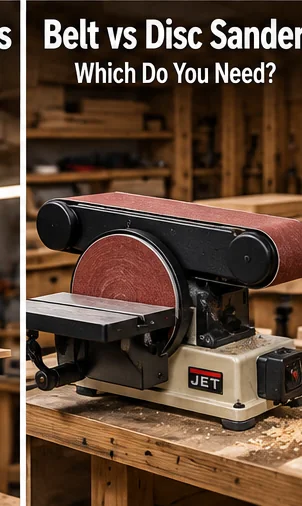
Machines and configurations to compare
Oscillating spindle sander
Oscillation spreads wear and reduces burning while multiple drum diameters reach different radii.
Best when: you cut curved templates, chair parts or scroll/bandsaw shapes
Watch for: less useful on long straight edges
4x36 belt + 6-inch disc sander
The combination machine gives two abrasive geometries in one footprint and is usually the broader first stationary sander.
Best when: you square ends, clean straight edges and shape outside curves
Watch for: inside concave curves are awkward or impossible
Benchtop edge belt sander
An edge sander gives longer platen support and more usable belt area for furniture parts than a small combo machine.
Best when: straight-edge sanding is frequent and production-like
Watch for: larger cost/space than a simple combo
Inside versus outside geometry decides the machine
A spindle fits inside concave curves. A belt excels on convex curves and straight edges. The disc references end grain against a table and miter gauge.
Oscillation reduces grooves and heat
Moving the spindle vertically distributes abrasive wear and reduces the tendency to cut a fixed groove into the workpiece.
Disc diameter limits usable surface
Only the downward-moving half of a disc should be used against the table; the upward side can lift the workpiece. That means a six-inch disc has a relatively small safe working zone.
Belt platen flatness affects joinery cleanup
A rigid flat platen is useful for truing edges and small parts, but sanding is still material removal by abrasion. Sneak up on layout lines rather than using the sander like a jointer.
Dust collection deserves priority
Stationary sanders create persistent fine dust. Connect the machine port and use appropriate respiratory protection during dusty work and cleanup.
Benchtop machines trade capacity for floor space, not necessarily accuracy
A well-made benchtop drill press or sander can be entirely adequate for furniture work. The usual compromises are throat depth, vertical capacity, table size, motor reserve and the amount of mass that damps vibration. If your stock fits within those limits, a benchtop machine can deliver excellent results while living on a cabinet or mobile workstation.
Floor machines become compelling when you routinely drill tall assemblies, swing large work around a column, or need the extra mass and power for large bits. The important question is not whether the floor model looks more professional; it is whether you repeatedly hit the physical limits of the benchtop format.
Dust collection is especially important at sanding machines
Sanders turn wood into fine airborne particles by design. NIOSH and OSHA both identify sanding as a meaningful wood-dust source. Connect the machine's dust port to effective extraction, keep the hood close to the abrasive where the design allows it, and do not assume the shop floor looking clean means the air is clean.
Abrasive choice matters too. Coarse grits shape quickly but can generate heat and deep scratches. Fine grits finish but clog faster. The machine should complement hand or random-orbit sanding rather than trying to replace every sanding operation.
Before checkout
- Machine fits the room with infeed and outfeed clearance
- Electrical circuit matches voltage and amperage requirements
- Dust port size matches the collection plan
- Guards, riving knife or cutter guards are present and usable
- Replacement blades, knives, inserts or belts are readily available
- Fence/table adjustments lock without visible deflection
- Mobile base or fixed placement is decided before assembly
- Noise and dust strategy are acceptable for the building
- Warranty and freight-return terms are understood
- First accessory budget includes blades/bits, dust adapters and work support
The hidden costs that belong in the machine budget
Cutters and consumables: the included blade, belt, knives or bits are often only a starting point. A premium ripping/crosscut blade, resaw blade, router bit or carbide inserts can materially change the machine. Put that cost in the first-day budget rather than judging the machine forever on the stock consumable.
Work support: long stock needs infeed/outfeed support; sheet goods need a breakdown surface; benchtop machines need a rigid stand or cabinet. Many disappointing machine purchases are really support-system problems.
Dust adapters and hose: machines rarely arrive with exactly the fitting your collector uses. Budget gates, reducers, short flex connections and, where appropriate, above-table or near-cutter pickup.
Electrical and mobility: a 230V circuit, mobile base or dedicated switch can change total installed cost significantly. A machine that blocks the shop when not in use has a real daily cost even if the invoice was cheap.
How to evaluate it in the first week
Before changing the factory setup aggressively, assemble the machine carefully, verify guards, check the table/fence/cutter relationships specified in the manual and make test cuts on known straight stock. Record the baseline. If a cut is wrong, diagnose one variable at a time: blade or cutter condition, fence alignment, table support, feed technique, dust buildup, then machine adjustment. Replacing several settings at once makes it harder to learn what the machine actually needed.
Keep the shipping material until the machine passes inspection. Large stationary tools are expensive to return by freight, and visible shipping damage should be documented before the crate or box disappears. Register the warranty, save the model/serial number and download the current manual; five years later those small administrative steps are surprisingly valuable.
Frequently asked questions
Which sander should I buy first?
For general furniture work, a belt/disc combo is broader. For frequent inside curves, buy the spindle sander first.
Can a belt sander replace a jointer?
No. It can clean or shape an edge but does not create the same reliable straight reference geometry.
Why does a spindle sander oscillate?
Oscillation spreads abrasive wear and reduces heat/grooving.
Do stationary sanders need dust collection?
Yes. Sanding produces fine airborne dust and should be connected to effective local extraction.
Primary references
Affiliate disclosure: WoodShopMachines.com may earn from qualifying purchases through Amazon Associates and eBay Partner Network at no extra cost to you. Product links are shopping paths, not evidence that a larger or more expensive machine is automatically the right choice.