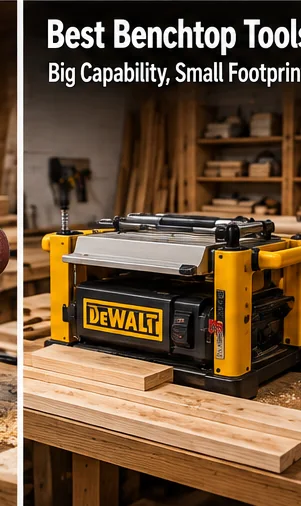
Machines and configurations to compare
120V 1.75HP class table saw
SawStop's current 1.75HP PCS and CNS examples run on 120V/14A, showing how capable a common-voltage machine can be.
Best when: you are in a garage with good dedicated 20A circuits
Watch for: large simultaneous loads can quickly exhaust circuit capacity
230V 3HP cabinet saw
SawStop currently lists the 3HP PCS at 230V/13A—roughly similar current to the 120V smaller motor while delivering more rated power.
Best when: thick hardwood ripping is routine and a dedicated 230V circuit is practical
Watch for: electrical installation and immobility become part of the purchase
Dual-voltage 14-inch bandsaw
Laguna's current 14|12 is a good example of a machine sold with dual-voltage capability.
Best when: you want to buy now on 120V and rewire later for a 230V shop
Watch for: rewiring must follow manufacturer instructions and correct plug/breaker rules
Voltage does not create free horsepower
A motor designed for dual voltage produces the same rated output after being correctly rewired. The current changes. The reason to prefer 240V is electrical distribution and access to machines that are only offered at higher voltage.
Dedicated circuits are the real upgrade
A planer drawing 15A plus a dust collector on the same 15A circuit is a nuisance. Good shops separate high-draw machines and collection so starting one does not trip the other.
Dust collection often drives the electrical plan
The collector runs whenever the primary machine runs. If both are near the limit of ordinary 120V circuits, adding 240V for one of them can simplify the whole shop.
Plan outlets around machine flow
A perfect circuit in the wrong wall encourages extension cords across infeed paths. Place receptacles where machines will actually park and where cords cannot cross material lanes.
Hire electrical work when appropriate
Panel capacity, breaker sizing, conductor gauge, receptacle type and local code are not places to improvise from a woodworking forum. If the installation requires new branch circuits, use qualified help as required.
Voltage is an infrastructure decision
A 120V machine is convenient because it can plug into a common receptacle, but a high-draw 15A machine already uses most of a typical 15A circuit. Moving larger motors to 240V reduces current for the same power and can make dedicated circuits more practical, but it requires the correct breaker, conductor, receptacle and machine wiring. Electrical modifications should follow local code and manufacturer instructions; hire a qualified electrician when the work goes beyond plug-and-play.
Do not use extension-cord convenience as the shop plan. Long undersized cords create voltage drop, heat and poor motor performance. Stationary machines are best served by appropriately located circuits so power, dust collection and material flow are designed together.
Motor horsepower only matters if the rest of the shop can support it
A 3HP cabinet saw or larger dust collector can be a meaningful upgrade, but the electrical circuit, breaker, receptacle and startup load have to support it. If installing 240V opens the door to several future machines, plan the panel and receptacle layout once rather than adding circuits one machine at a time.
For small shops, mobility can be as valuable as horsepower. A 1.75HP machine on a good mobile base that actually gets used may be more productive than a 3HP machine permanently blocking the garage door.
Before checkout
- Machine fits the room with infeed and outfeed clearance
- Electrical circuit matches voltage and amperage requirements
- Dust port size matches the collection plan
- Guards, riving knife or cutter guards are present and usable
- Replacement blades, knives, inserts or belts are readily available
- Fence/table adjustments lock without visible deflection
- Mobile base or fixed placement is decided before assembly
- Noise and dust strategy are acceptable for the building
- Warranty and freight-return terms are understood
- First accessory budget includes blades/bits, dust adapters and work support
The hidden costs that belong in the machine budget
Cutters and consumables: the included blade, belt, knives or bits are often only a starting point. A premium ripping/crosscut blade, resaw blade, router bit or carbide inserts can materially change the machine. Put that cost in the first-day budget rather than judging the machine forever on the stock consumable.
Work support: long stock needs infeed/outfeed support; sheet goods need a breakdown surface; benchtop machines need a rigid stand or cabinet. Many disappointing machine purchases are really support-system problems.
Dust adapters and hose: machines rarely arrive with exactly the fitting your collector uses. Budget gates, reducers, short flex connections and, where appropriate, above-table or near-cutter pickup.
Electrical and mobility: a 230V circuit, mobile base or dedicated switch can change total installed cost significantly. A machine that blocks the shop when not in use has a real daily cost even if the invoice was cheap.
How to evaluate it in the first week
Before changing the factory setup aggressively, assemble the machine carefully, verify guards, check the table/fence/cutter relationships specified in the manual and make test cuts on known straight stock. Record the baseline. If a cut is wrong, diagnose one variable at a time: blade or cutter condition, fence alignment, table support, feed technique, dust buildup, then machine adjustment. Replacing several settings at once makes it harder to learn what the machine actually needed.
Keep the shipping material until the machine passes inspection. Large stationary tools are expensive to return by freight, and visible shipping damage should be documented before the crate or box disappears. Register the warranty, save the model/serial number and download the current manual; five years later those small administrative steps are surprisingly valuable.
Frequently asked questions
Does 240V cost less to run?
Not inherently for the same power/work. The advantage is lower current and support for larger motors/circuits.
Can I convert a 120V machine to 240V?
Only if the motor/machine is specifically designed and documented for dual-voltage conversion.
Do I need 240V for a 1.75HP table saw?
Usually no; current SawStop 1.75HP examples operate on 120V.
What machines most often justify 240V?
3HP cabinet saws, larger dust collectors, heavy planers/jointers and other higher-horsepower stationary equipment.
Primary references
- SawStop Professional Cabinet Saw — current official specs
- SawStop Contractor Saw — current official specs
- Laguna 14|12 Bandsaw — current official specs
- OSHA Woodworking eTool
Affiliate disclosure: WoodShopMachines.com may earn from qualifying purchases through Amazon Associates and eBay Partner Network at no extra cost to you. Product links are shopping paths, not evidence that a larger or more expensive machine is automatically the right choice.