Affiliate disclosure: WoodShopMachines.com may earn from qualifying purchases through Amazon Associates and eBay Partner Network at no extra cost to you. Product links are shopping paths, not evidence that a larger or more expensive machine is automatically the right choice.
What shank size means and what sizes exist
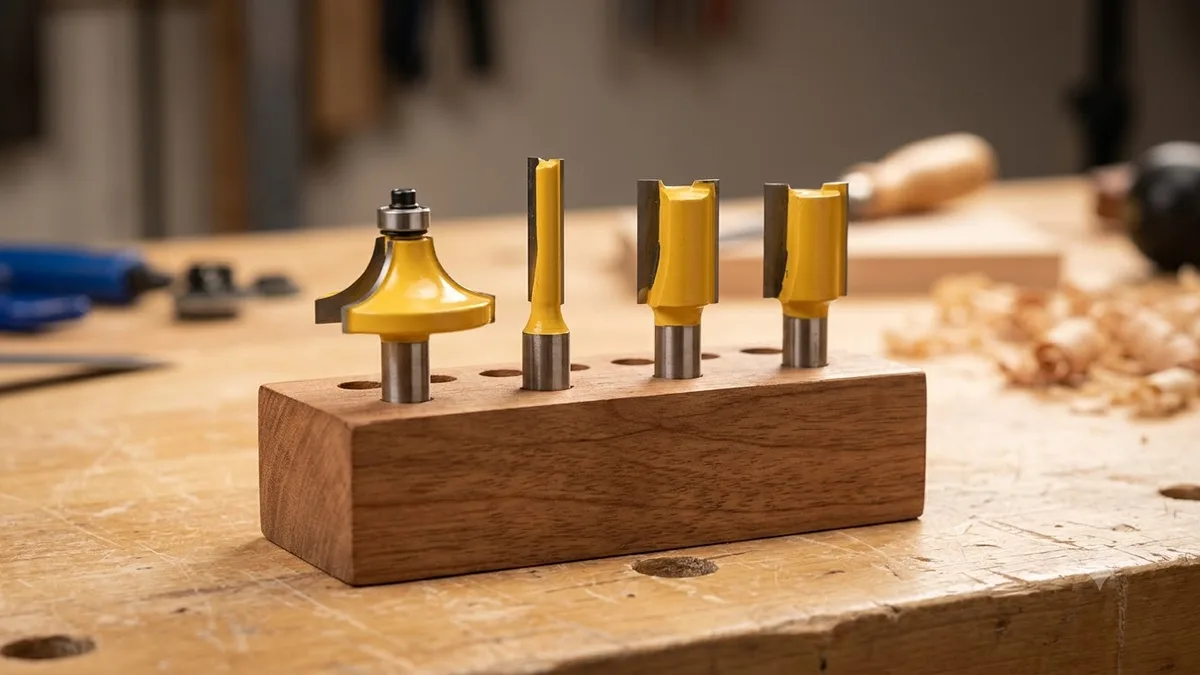
A router bit has a cutting head and a round shank. The router's collet clamps the shank, and the collet nut tightens it. Shank diameter is the number on the bit that has to match the collet. A general reference on routers lists common shank diameters from thickest to thinnest as half-inch, 12 mm, 10 mm, three-eighths inch, 8 mm, a quarter inch and 6 mm. In the U.S. the two you will meet most are quarter-inch and half-inch.
The reference adds that many routers come with removable collets for the popular sizes, and that which sizes are common varies by region: half-inch and quarter-inch in the U.S., with 8 mm also common in Great Britain and metric sizes in Europe. It also notes that three-eighths inch and 8 mm collets are often sold only at extra cost in the U.S. If you buy bits from overseas sellers, check the shank is in a size your collet accepts.
Router tables use a plate or lift to hold a router upside down. Your choice of shank size is partly decided by the router. Some compact routers take only a quarter inch; many full-size routers take both with two collets. Read the manual or the collet markings before you shop. The site's router tables guide and router bits page give the wider picture.
The collet must match the shank
This is the rule that overrides everything else. The reference says care must be taken to ensure the bit shank and router collet sizes match exactly, and that a mismatch can lead to the dangerous situation of the bit coming out of the collet during operation. A collet is made for one shank size. A shank that is too small does not grip; one that is too big will not go in.
Sellers offer reducer sleeves that let a larger collet hold a smaller shank, and some woodworkers use them. Whether a sleeve is appropriate for your router and bit is a question for the router maker, not a forum. Check the router manual for what it permits and do not use a sleeve with a large bit unless the maker says it is suitable. A sleeve adds another joint to the grip, which is one reason to buy the right shank size where you can.
Check the collet itself while you are there. A worn, dirty or damaged collet will hold a bit poorly even if the sizes match. Clean it, look for scoring or distortion, and replace it if it is damaged. Follow the manual on how deep to insert the shank and how tight to make the nut; those depend on the router.
Replacement router collet
Search the collet size and your router model, and buy the part made for your router or its maker. A collet is a precision part, so compare it with the parts diagram and avoid generic fit claims.
Stiffness, vibration and large bits
Half-inch shanks have more steel in the grip and less flex. The reference page says half-inch bits cost more but, being stiffer, are less prone to vibration, which gives smoother cuts, and are less likely to break than the smaller sizes. That is the main reason router table users choose them: the bit is spinning upside down with a long, heavy cutter, and every bit of flex shows in the cut.
Size matters too. The reference notes that a slower rotation allows bits of larger cutting diameter to be used safely, and that for safety larger cutters can usually only be used in a router that is mounted in a router table. That is another point for the half-inch shank, since big profile and panel bits are typically made on that size. Whether a router has the speed control to run a big bit slowly is in its specifications, so check that before buying a large cutter.
A quarter-inch shank is not wrong. It suits small roundovers, small straight bits, chamfers and detail work where the cut is light. A smaller shank also fits a compact router that a half-inch collet would not. The point is to match the shank to the job and the machine. For a router table that does a lot of work, a router with a half-inch collet is the better foundation, and the router lift roundup and router table fence roundup cover the rest of the table setup.
Bits that come in only one size
Some bits are offered in only one shank size. As a general pattern, small detail and trim bits often come in quarter-inch only, and large cutters such as panel-raising and big profile bits are made on half-inch shanks only. Many ordinary bits, such as straight bits, roundovers and chamfers, come in both. Check the product listing for the shank size, because titles are sometimes vague and a photo does not show it.
When a bit you want comes in both sizes, choose half-inch if your router has the collet and the bit will see heavy use. When it comes only in quarter-inch, accept that and keep the cut light. When it comes only in half-inch and your router takes only quarter-inch, the choice is a different bit, a different router or a different technique. Do not force a large bit into a small machine.
If you are putting together a bit collection, see woodshop stocking stuffers for ideas on spare bits and consumables, and the Forstner bit sets post if you also drill with a press.
Half-inch shank router bit set
Look for the shank size in the listing title and specifications, and confirm that every bit in the set suits your router speed range. A set is a starting point; buy single bits for profiles you use often.
A short buying checklist
| Check | Why it matters |
|---|---|
| Collet size in your router | The shank must match exactly |
| Shank size in the listing | Titles and photos are often unclear |
| Cutter diameter | Large cutters need low speed and a router table |
| Router speed control | Needed to slow large bits; see the router's specifications |
| Collet condition | A worn collet holds poorly regardless of size |
| Table plate or lift opening | The bit must pass through the opening |
If you are buying a used router table, plate or router, the used router table inspection page covers what to check, and the router table safety page covers safe use. Unplug before changing bits every time. Do not run a bit in a router whose manual does not allow it.
Frequently asked questions
Is a half-inch router bit shank better than a quarter-inch?
For router tables and larger cutters, generally yes. A general reference says half-inch bits are stiffer, less prone to vibration and less likely to break, though they cost more.
Can I use a quarter-inch bit in a half-inch collet?
Only if the router maker approves a method such as a reducer sleeve. The shank must otherwise match the collet exactly, because a mismatch can let the bit come out while running.
Do all routers take both sizes?
No. Some take only quarter-inch, and many full-size routers have removable collets for several sizes. Check your router manual.
Why do some bits only come in half-inch?
Large cutters such as big profile and panel bits are typically made on the stiffer shank. Check the listing for the shank size.
How do I check the shank size before buying?
Read the listing specifications, not only the title or photo, and compare with the collet size stamped on your router or in its manual.
Sources and verification
- Wikipedia: Router (woodworking) (a general reference), for the list of common shank diameters, the warning that bit shank and collet sizes must match exactly, regional collet sizes, the note on half-inch bits being stiffer, the point that slower rotation allows larger cutting diameters and the note that larger cutters are usually for router-table use.
No speeds, bit diameters, insertion depths or torque figures are quoted. Reducer sleeves are mentioned only as something to check with the router maker. Confirm collet size, speed range and the maximum bit diameter in your router's manual and on the bit maker's specification.