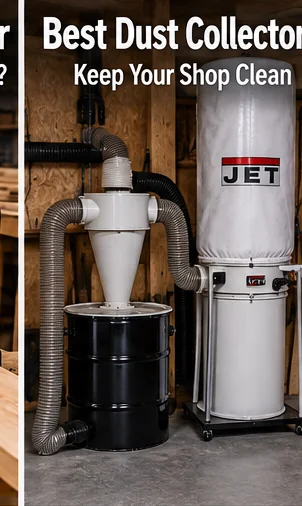
Machines and configurations to compare
4-inch smooth-wall duct
Four-inch is easy to source and matches many hobby machines directly. Smooth rigid pipe performs better than long corrugated flex.
Best when: you use a 1–1.5HP collector and short runs
Watch for: limits total airflow as the system grows
6-inch main duct with machine reductions
Six-inch mains are common when the goal is high air volume at table-saw, planer and jointer hoods across longer runs.
Best when: your collector is sized for a real duct system and several large hoods
Watch for: requires larger fan, more room and careful branch design
4-inch flex hose for final drops
Use flex only where movement is needed. Long coils of corrugated hose can consume a surprising amount of collector performance.
Best when: you need movement and vibration isolation at the machine
Watch for: flex has much more resistance than smooth pipe
Diameter changes cross-sectional area dramatically
A six-inch circle has more than twice the area of a four-inch circle. That creates the potential for much higher airflow, but only if the blower can move that volume against the system pressure.
Velocity still matters
Dust and chips need enough air velocity to remain suspended. An oversized duct on a small fan can slow the air enough that heavier material drops out.
Machine hood openings can be the real choke point
A 6-inch trunk reduced to a poorly designed 2½-inch port at the tool cannot fix the hood. Sometimes modifying collection at the source produces a bigger improvement than replacing the entire duct network.
Flex hose is expensive in pressure loss
Corrugations create turbulence. Use smooth pipe for the long run and the shortest practical flexible connection at the machine.
Design for the hardest machine
The planer may need chip volume, the table saw may need above-and-below pickup, and the sander may need fine-particle capture. Build the main around the highest legitimate airflow requirement rather than averaging all machines.
Dust collection is about air at the machine, not the catalog CFM number
Collector airflow is only the beginning. Hose diameter, duct length, elbows, flex hose, blast gates, filters and the machine's hood geometry all subtract from the air that reaches the cutter. A system advertised at a huge free-air number can perform poorly at the machine if the duct is undersized or the filter is loaded.
Large chips and fine airborne dust are also different problems. A planer can fill a bag with chips while still releasing fine dust into the room. A table saw often needs collection both below the blade and above the guard. Sanding produces relatively little chip volume but a great deal of fine dust. Design around the machines that are hardest to capture, not the machine with the biggest dust port.
Filtration and separation solve different problems
A cyclone or separator keeps chips out of the filter, preserving airflow and making disposal easier. The final filter controls what small particles return to the room. You want both good separation and fine filtration. A huge collector with a coarse bag can move a lot of air while redistributing fine dust through the shop.
Wood dust is not merely a cleanliness issue. OSHA notes respiratory, skin and other health hazards associated with wood dust, and local exhaust at the point of generation is a primary control. Dust collection should therefore be treated as shop infrastructure rather than an optional accessory.
Before checkout
- Machine fits the room with infeed and outfeed clearance
- Electrical circuit matches voltage and amperage requirements
- Dust port size matches the collection plan
- Guards, riving knife or cutter guards are present and usable
- Replacement blades, knives, inserts or belts are readily available
- Fence/table adjustments lock without visible deflection
- Mobile base or fixed placement is decided before assembly
- Noise and dust strategy are acceptable for the building
- Warranty and freight-return terms are understood
- First accessory budget includes blades/bits, dust adapters and work support
The hidden costs that belong in the machine budget
Cutters and consumables: the included blade, belt, knives or bits are often only a starting point. A premium ripping/crosscut blade, resaw blade, router bit or carbide inserts can materially change the machine. Put that cost in the first-day budget rather than judging the machine forever on the stock consumable.
Work support: long stock needs infeed/outfeed support; sheet goods need a breakdown surface; benchtop machines need a rigid stand or cabinet. Many disappointing machine purchases are really support-system problems.
Dust adapters and hose: machines rarely arrive with exactly the fitting your collector uses. Budget gates, reducers, short flex connections and, where appropriate, above-table or near-cutter pickup.
Electrical and mobility: a 230V circuit, mobile base or dedicated switch can change total installed cost significantly. A machine that blocks the shop when not in use has a real daily cost even if the invoice was cheap.
How to evaluate it in the first week
Before changing the factory setup aggressively, assemble the machine carefully, verify guards, check the table/fence/cutter relationships specified in the manual and make test cuts on known straight stock. Record the baseline. If a cut is wrong, diagnose one variable at a time: blade or cutter condition, fence alignment, table support, feed technique, dust buildup, then machine adjustment. Replacing several settings at once makes it harder to learn what the machine actually needed.
Keep the shipping material until the machine passes inspection. Large stationary tools are expensive to return by freight, and visible shipping damage should be documented before the crate or box disappears. Register the warranty, save the model/serial number and download the current manual; five years later those small administrative steps are surprisingly valuable.
Frequently asked questions
Is 6-inch always better?
No. The collector must be capable of moving sufficient air through 6-inch duct while maintaining transport velocity.
Can I connect a 6-inch main to 4-inch machines?
Yes, with properly designed branches/reductions; the machine hood may still limit airflow.
Should I use PVC or metal duct?
Both are used in hobby shops, but installation, grounding/static guidance, fire code and local requirements should be considered. Follow applicable standards.
How much flex hose should I use?
As little as practical. Smooth rigid runs usually have much lower resistance.
Primary references
Affiliate disclosure: WoodShopMachines.com may earn from qualifying purchases through Amazon Associates and eBay Partner Network at no extra cost to you. Product links are shopping paths, not evidence that a larger or more expensive machine is automatically the right choice.