Affiliate disclosure: WoodShopMachines.com may earn from qualifying purchases through Amazon Associates and eBay Partner Network at no extra cost to you. Product links are shopping paths, not evidence that a larger or more expensive machine is automatically the right choice.
Why the stand matters more than people expect
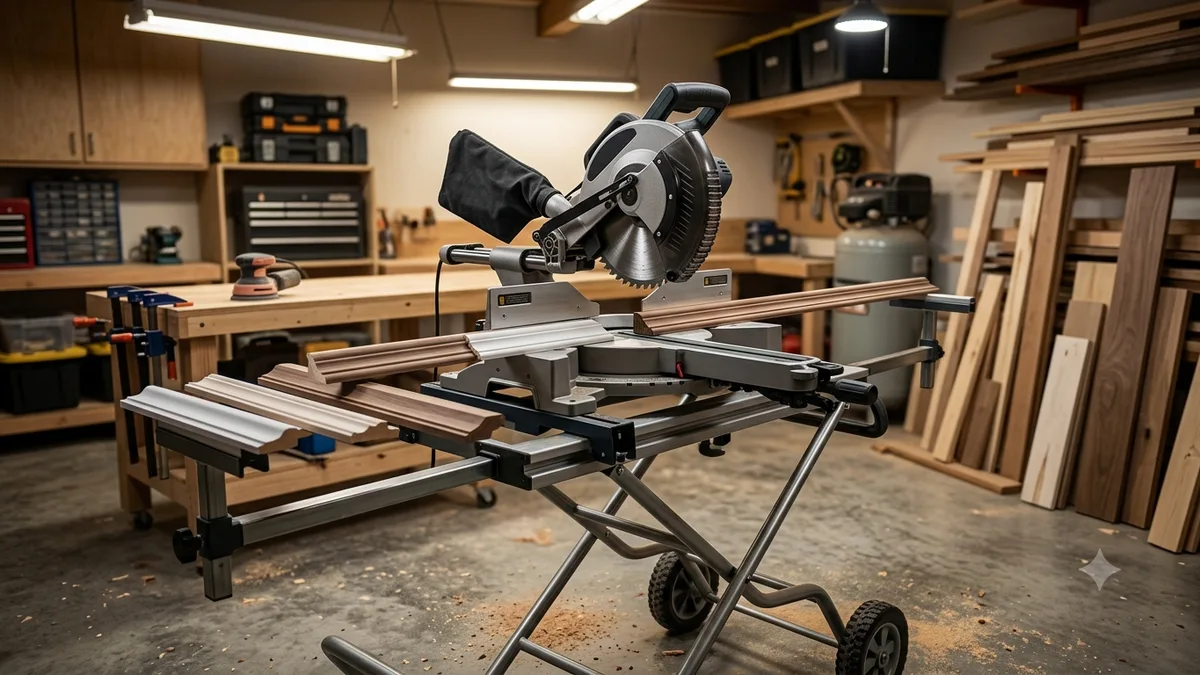
A miter saw cuts with a swinging or sliding head, and the board is held against a fence while the blade comes down. A general reference on miter saws notes that the work must be supported at the far end to stabilize the piece while cutting, and that the miter table is relatively small, so longer boards hang well past it. Without level support under that overhang, boards rock, the cut wanders and the board can be thrown.
The stand or station does three jobs. It holds the saw at a comfortable height. It gives a stable footing so the saw does not walk or tip during a cut. And it supports the board on both sides of the blade at the same height as the saw's table. Judge a stand by how well it does these three things, not by how it folds.
The same reference says most miter saws are relatively small and portable, and that sliding compound models are portable, easy to set up and robust enough to keep accuracy when moved. That portability is why folding stands are so common, but a portable saw is not always a stable one, and stability is where the choice gets interesting. If you are still deciding on a saw, the site's 10-inch vs 12-inch miter saw comparison covers capacity.
Folding stands
Folding stands collapse flat or into a small bundle and are the lightest option. They suit people who store the saw in a closet or truck and set it up for a day's work. Most have legs that lock open, brackets or rails to hold the saw, and extending arms for support.
The weak points are stability and support. A lightweight stand can flex or shift under a heavy saw, on soft ground or with a long, heavy board hanging off one side. Check how the legs lock, how wide the footprint is and whether feet or levelers let you set the stand firmly on uneven ground. Look at how the saw is clamped or bolted to the stand and follow the saw manual for that. Weight limits are on the product page or in the manual. The stand's rating has to cover the saw plus a share of the load of the board.
For a saw that moves between sites, a folding stand is hard to beat for portability. For a saw that stays put in a garage, it usually leaves you wanting more support and mass.
Folding miter saw stand
Compare the stated load rating with your saw's weight from its spec sheet, and check that the saw mounting holes or brackets suit your model. Used stands turn up regularly on eBay; check that the legs lock and nothing is bent.
Rolling stands and mobile bases
Rolling stands add wheels, either on the stand itself or on a mobile base that the saw sits on. They suit shops where space is short and the saw has to move out of the way. A mobile base should lock firmly and lift or lower wheels so the base stays still when you cut. The site's mobile bases roundup and casters and leveling feet post cover wheels and locks in more detail.
The risk is movement. A stand that rolls even slightly while you cut is a problem, so look for wheels that lock hard, or retractable wheels that lower the frame onto feet. Heavy saws and long boards put more pressure on wheels, and casters with a low rating can fail under load. Read the load rating and the lock design on each wheel.
A rolling stand also depends on your floor. A smooth, flat concrete floor works. Gravel, cracks and sloping garage floors make wheels less stable. If your floor is uneven, adjustable feet or a solid station may suit you better than any wheeled unit.
A fixed station or built-in bench
A fixed station is a bench or cabinet with the saw sunk in or set on top, with wings or tables either side at the saw's table height and a long fence across them. It is usually built in the shop, sometimes bought as a kit, and it has the most mass and the best support for long boards.
It also offers the best chance to deal with dust. The reference calls dust removal with these saws notoriously poor because of the exposed blade area. A fixed station can have a hood or enclosure behind the saw and a connection to a dust collector; see the site's miter saw dust collection guide for ideas. Dust matters for health as well as cleanup, so plan collection when you plan the station.
The drawbacks are space and commitment. A station takes up a wall and cannot be moved at will. You also have to align the wings to the saw table, and the saw table to the fence. That is worth doing with a straightedge, and the work pays back every time you cut a long board. Storage under the saw is a bonus, but do not let clutter pile up around a machine that throws chips.
Miter saw material support and stop
Look for a support that adjusts to the saw table height and a stop that slides along the fence. Check the listing for the height range and the fence compatibility before ordering.
Side-by-side comparison
| Factor | Folding | Rolling | Fixed station |
|---|---|---|---|
| Stability | Fair, depends on the build and ground | Fair to good if wheels lock firmly | Best |
| Long board support | Limited by arm length | Varies by model | Best, built to length |
| Storage | Folds away | Rolls aside | Takes a wall |
| Portability | High | Moderate | None |
| Dust control | Hard | Hard | Easiest to add |
| Cost | Lower | Moderate | Highest in time or money |
The ratings are general, not measured, so check the specific stand. Whichever you pick, set the saw so that the board is supported level on both sides, the fence is straight, and the saw cannot shift. If you cut with different blades for different work, the miter saw blade tooth count guide helps match the blade to the job.
Gifts for a beginner often include a stand; the first small shop gift guide, gifts for a woodworker building a first small shop, shows where it fits in the overall setup. For the saw itself, the site's sliding miter saws and compound miter saws guides explain the types, and miter saw safety covers guards and clamps.
Frequently asked questions
Do I need a stand for a miter saw?
Not always, but the saw needs a stable surface at a comfortable height and support for long boards. A stand or station is the usual way to provide both.
Is a folding stand stable enough?
It can be if it locks firmly, sits on a flat surface and is rated for the saw. Lightweight stands can flex under heavy saws or long boards.
Is a fixed miter saw station worth building?
If the saw stays in the shop, yes for many people. It offers the best stability, long-board support and dust control, at the cost of space and time.
How do I support long boards on a miter saw?
Support them level with the saw table at both ends so the board cannot tip or rock. A general reference notes that work needs support at the far end to stabilize it.
Can I collect dust from a miter saw on a stand?
Partly. Saw dust ports and bags catch some, and a fixed station can add a hood and dust collector connection. Collection is hard on any miter saw.
Sources and verification
- Wikipedia: Miter saw (a general reference), for the notes on supporting work at the far end, the size of the miter table, the portability of sliding compound models, poor dust removal and blade guards.
The reference has no content on stands or stations, so the comparison of stand types is practical guidance, not a tested ranking. No load ratings, weights, heights or dimensions are quoted. Confirm the stand's rating, the saw's weight and the mounting method in the stand's instructions and your saw's manual.