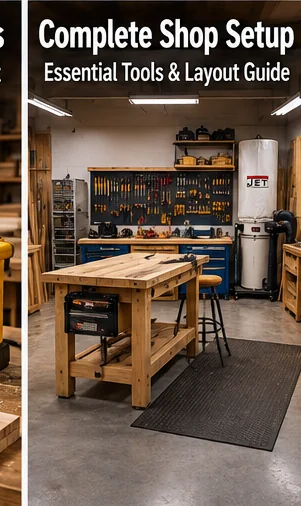
Machines and configurations to compare
Core cutting station
Most shops revolve around either a table saw plus track saw or a compact saw workflow with strong material support.
Best when: you need repeatable ripping/crosscutting and sheet breakdown
Watch for: choose based on room and sheet-goods workflow rather than brand status
13-inch thickness planer
A benchtop planer is one of the highest-leverage machines because it changes what lumber you can buy and lets every project use custom thickness.
Best when: you want to control lumber thickness and buy rough/S2S stock
Watch for: chip volume demands real collection
Dust collection + extractor pair
A large-hose collector handles chips and big hoods; a high-pressure extractor handles sanders and small portable-tool ports.
Best when: you run stationary machines plus handheld sanders/routers
Watch for: two collection styles cost more but solve different airflow problems
Phase 1: cutting and work support
Start with a reliable straight-cut strategy and a flat assembly/outfeed surface. In a tiny shop, that may mean track saw + multifunction table before a cabinet saw. In a dedicated garage, a 30–36-inch table saw becomes the center.
Phase 2: lumber preparation
A planer unlocks rough/S2S lumber. Add a jointer when flattening sleds and edge-straightening jigs become the bottleneck. The order depends on how often you mill rough stock.
Phase 3: routing and drilling
A quality handheld router can do edge profiles, dados, mortises and template work. A router table comes later when repeated small-part work justifies it. A benchtop drill press adds repeatability without consuming a full machine island.
Phase 4: curves and resawing
The bandsaw becomes essential when projects regularly include curved components, veneer/resawing or rough blank breakdown. Otherwise, it can wait while jigsaw/track/table saws cover straight work.
Phase 5: specialized sanding
Stationary sanders save handwork when the same geometry appears repeatedly. Buy the spindle sander because inside curves are constant, or the belt/disc because edge/end shaping is constant—not because the catalog has a blank spot.
The layout should stay flexible
Mobile bases, shared infeed lanes and cabinets under benchtop machines let a small shop expand without freezing the floor plan. The shop will teach you where machines belong after six months of real projects.
The shop is a material-flow problem
A machine's footprint is only the beginning. Every saw, jointer, planer and drill press has an infeed and outfeed zone that can be several times longer than the machine itself. The best small shops overlap those zones intentionally: a planer can feed through the same aisle used by the table saw, a mobile assembly table can double as outfeed support, and a miter station can use wall length that would otherwise be dead space.
Start with the longest stock you actually use, not the room drawing. Lay an eight-foot board or full plywood sheet on the floor and walk the path it must take through each operation. That exercise exposes blocked doors, impossible turns and machines that need casters before you spend a dollar.
Buy bottlenecks, not a complete catalog
A first shop does not need every stationary machine. A table saw or track saw, planer, router, dust extraction and drilling solution can build a surprising amount of furniture. Add a jointer when rough lumber flattening becomes frequent, a bandsaw when curves/resawing become regular, and specialized sanders when they save repeated handwork.
The right machine is the one that removes a recurring bottleneck. Keeping that rule prevents a garage from turning into machine storage with no room left to build.
Before checkout
- Machine fits the room with infeed and outfeed clearance
- Electrical circuit matches voltage and amperage requirements
- Dust port size matches the collection plan
- Guards, riving knife or cutter guards are present and usable
- Replacement blades, knives, inserts or belts are readily available
- Fence/table adjustments lock without visible deflection
- Mobile base or fixed placement is decided before assembly
- Noise and dust strategy are acceptable for the building
- Warranty and freight-return terms are understood
- First accessory budget includes blades/bits, dust adapters and work support
The hidden costs that belong in the machine budget
Cutters and consumables: the included blade, belt, knives or bits are often only a starting point. A premium ripping/crosscut blade, resaw blade, router bit or carbide inserts can materially change the machine. Put that cost in the first-day budget rather than judging the machine forever on the stock consumable.
Work support: long stock needs infeed/outfeed support; sheet goods need a breakdown surface; benchtop machines need a rigid stand or cabinet. Many disappointing machine purchases are really support-system problems.
Dust adapters and hose: machines rarely arrive with exactly the fitting your collector uses. Budget gates, reducers, short flex connections and, where appropriate, above-table or near-cutter pickup.
Electrical and mobility: a 230V circuit, mobile base or dedicated switch can change total installed cost significantly. A machine that blocks the shop when not in use has a real daily cost even if the invoice was cheap.
How to evaluate it in the first week
Before changing the factory setup aggressively, assemble the machine carefully, verify guards, check the table/fence/cutter relationships specified in the manual and make test cuts on known straight stock. Record the baseline. If a cut is wrong, diagnose one variable at a time: blade or cutter condition, fence alignment, table support, feed technique, dust buildup, then machine adjustment. Replacing several settings at once makes it harder to learn what the machine actually needed.
Keep the shipping material until the machine passes inspection. Large stationary tools are expensive to return by freight, and visible shipping damage should be documented before the crate or box disappears. Register the warranty, save the model/serial number and download the current manual; five years later those small administrative steps are surprisingly valuable.
Frequently asked questions
What is the first stationary machine I should buy?
For many shops it is a table saw; for sheet-goods-heavy tiny shops a track saw may come first.
When should I add a jointer?
When planer sleds, ripped straight edges and other flattening workarounds become a recurring time bottleneck.
Do I need both a dust collector and shop vacuum?
Often yes. Large stationary ports need airflow volume; handheld tools with small ports benefit from high static pressure.
Which machine can wait the longest?
Usually the machine tied to the least common operation in your projects—often a specialized sander or large drill press.
Primary references
- DEWALT DW735 — current official specs
- SawStop Professional Cabinet Saw — current official specs
- Laguna B|Flux — current official specs
- OSHA Woodworking eTool
- OSHA — Wood Dust
Affiliate disclosure: WoodShopMachines.com may earn from qualifying purchases through Amazon Associates and eBay Partner Network at no extra cost to you. Product links are shopping paths, not evidence that a larger or more expensive machine is automatically the right choice.