Machines and configurations to compare
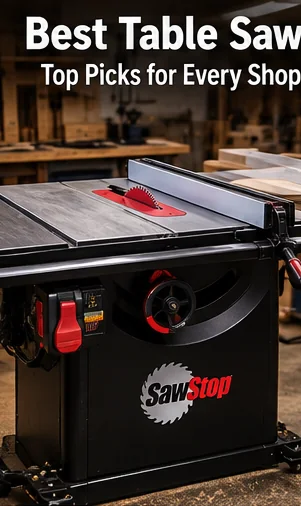
SawStop Professional Cabinet Saw 1.75HP / 30–36 in fence
Current SawStop specs keep the 1.75HP PCS at 120V/14A with 30-, 36- and 52-inch fence choices. In a small shop, the shorter fence options preserve the same core saw without turning one wall into rail storage.
Best when: you want cabinet-saw mass, the SawStop brake and can dedicate floor space
Watch for: heavy and expensive; the 52-inch rail is usually overkill in a small room
SawStop Contractor Saw 1.75HP / 36 in
The Contractor Saw can be configured with a serious T-Glide fence and mobile base while staying on 120V. It is a strong middle ground between a jobsite saw and a cabinet saw.
Best when: you want a full cast-iron table and SawStop safety but expect to move the saw
Watch for: open stand occupies more front-to-back depth than the PCS cabinet
10-inch jobsite table saw with rack-and-pinion fence
Modern jobsite saws are capable machines when paired with a stable outfeed/assembly table. The trade is not necessarily cut quality; it is support area, mass, noise and long-term fence/table feel.
Best when: the shop shares space with vehicles and the saw must store against a wall
Watch for: smaller table and lighter chassis need better external support
Start with the room, not the saw
A 52-inch fence can add almost three feet of rail/table to the right side of the blade. In a one-car garage that width may block a door, dust collector or assembly path. Measure the saw with rails, motor cover and mobile base installed, then draw the infeed/outfeed path for eight-foot stock.
1.75HP is enough more often than enthusiasts admit
A sharp full-kerf or thin-kerf blade and a sensible feed rate let a 1.75HP saw handle ordinary furniture stock. Three horsepower becomes useful when thick hardwood ripping is frequent and production speed matters. If the 3HP upgrade forces new electrical work and a larger fixed footprint, price that infrastructure as part of the saw.
Thirty-six inches of rip is a practical ceiling for many home shops
A 36-inch fence handles most cabinet sides and furniture work. Full-sheet breakdown is often safer and easier with a track saw first, then final dimensioning on the table saw. Designing the shop around rare 48-inch rips can make every normal operation worse.
Mobility should be engineered, not improvised
A good integrated mobile base lets a heavy saw move without rocking during a cut. Cheap universal casters can raise working height, flex the stand or leave the machine difficult to level. If the saw will move weekly, treat the base as part of the original purchase.
Dust collection belongs at the blade
Bottom cabinet collection alone misses dust thrown above the table. A blade guard with extraction plus a sealed lower cabinet can materially improve capture, especially when sheet goods are cut frequently.
Accuracy is a system, not a motor rating
A woodworking machine can have plenty of horsepower and still produce frustrating work if the reference surfaces are weak. On saws, the fence, table flatness, arbor runout, blade quality and alignment between blade and miter slot determine whether a rip closes cleanly or wanders. Before upgrading to a larger motor, make sure the machine can repeatedly return to the same setting. A sharp, appropriate blade on a well-aligned modest saw often outperforms a powerful saw with a mediocre fence.
Material support belongs in the accuracy conversation too. Sheet goods and eight-foot boards create leverage against the fence and table. Outfeed support, roller stands or a track-saw breakdown workflow can improve accuracy more than another horsepower increment because the operator is no longer fighting the workpiece.
Cut capacity should match the stock you buy
Maximum rip, crosscut and depth numbers are useful only when they correspond to your lumber. Cabinet shops processing sheet goods care about rip capacity and crosscut strategy; furniture builders often care more about repeatable narrow ripping and safe joinery. A 52-inch fence can be wonderful in a large shop and ridiculous in a one-car garage where the rail blocks the walking path every day.
Think in terms of recurring stock, not hypothetical stock. If you routinely bring home 4×8 plywood, build a workflow for those sheets. If you mostly mill 6-inch hardwood boards, a giant panel capacity may be wasted space.
Before checkout
- Machine fits the room with infeed and outfeed clearance
- Electrical circuit matches voltage and amperage requirements
- Dust port size matches the collection plan
- Guards, riving knife or cutter guards are present and usable
- Replacement blades, knives, inserts or belts are readily available
- Fence/table adjustments lock without visible deflection
- Mobile base or fixed placement is decided before assembly
- Noise and dust strategy are acceptable for the building
- Warranty and freight-return terms are understood
- First accessory budget includes blades/bits, dust adapters and work support
The hidden costs that belong in the machine budget
Cutters and consumables: the included blade, belt, knives or bits are often only a starting point. A premium ripping/crosscut blade, resaw blade, router bit or carbide inserts can materially change the machine. Put that cost in the first-day budget rather than judging the machine forever on the stock consumable.
Work support: long stock needs infeed/outfeed support; sheet goods need a breakdown surface; benchtop machines need a rigid stand or cabinet. Many disappointing machine purchases are really support-system problems.
Dust adapters and hose: machines rarely arrive with exactly the fitting your collector uses. Budget gates, reducers, short flex connections and, where appropriate, above-table or near-cutter pickup.
Electrical and mobility: a 230V circuit, mobile base or dedicated switch can change total installed cost significantly. A machine that blocks the shop when not in use has a real daily cost even if the invoice was cheap.
How to evaluate it in the first week
Before changing the factory setup aggressively, assemble the machine carefully, verify guards, check the table/fence/cutter relationships specified in the manual and make test cuts on known straight stock. Record the baseline. If a cut is wrong, diagnose one variable at a time: blade or cutter condition, fence alignment, table support, feed technique, dust buildup, then machine adjustment. Replacing several settings at once makes it harder to learn what the machine actually needed.
Keep the shipping material until the machine passes inspection. Large stationary tools are expensive to return by freight, and visible shipping damage should be documented before the crate or box disappears. Register the warranty, save the model/serial number and download the current manual; five years later those small administrative steps are surprisingly valuable.
Frequently asked questions
Is a cabinet saw too big for a one-car garage?
Not necessarily. A 30- or 36-inch fence cabinet saw on a good mobile base can work well if infeed/outfeed lanes are planned.
Do I need 3HP?
Not for most hobby furniture work. It is most useful for frequent thick-hardwood ripping and production throughput.
Should I buy a track saw instead?
If sheet breakdown and storage space dominate your work, a track saw can be the better first purchase; many shops eventually use both.
How much rip capacity do I really need?
For many home shops 30–36 inches is enough when full sheets are rough-cut with another method.
Primary references
- SawStop Professional Cabinet Saw — current official specs
- SawStop Contractor Saw — current official specs
- OSHA Woodworking eTool
- NIOSH — Control of Wood Dust From Table Saws
Affiliate disclosure: WoodShopMachines.com may earn from qualifying purchases through Amazon Associates and eBay Partner Network at no extra cost to you. Product links are shopping paths, not evidence that a larger or more expensive machine is automatically the right choice.