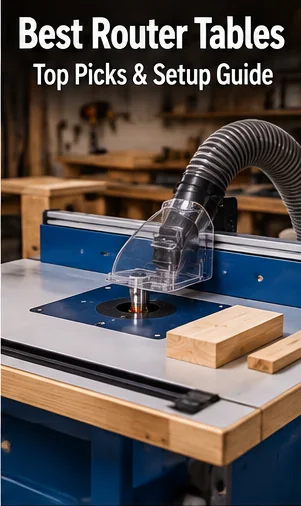
Machines and configurations to compare
Bosch RA1181 benchtop router table
Bosch currently lists a large aluminum top, tall fence, featherboards and a 2½-inch dust port in a roughly 30-pound benchtop package.
Best when: you need a complete portable table that can live on a shelf or cabinet
Watch for: 27-inch-wide top is smaller than full floor systems
Kreg PRS1045 Precision Router Table System
Kreg's current system uses a 24×32-inch top, heavy insert plate and adjustable steel stand with a self-squaring fence.
Best when: routing is frequent and you want a large stable top plus T-square-style fence
Watch for: takes dedicated floor space and costs much more than benchtop tables
Table-saw-wing router table
Using table-saw rail space for the router converts existing footprint into a second machine without adding another island to the shop.
Best when: your saw supports an insert/router wing and you want one combined station
Watch for: router dust hoses, fence storage and switch placement need careful planning
The insert plate is the heart of the system
It needs to stay flush with the surrounding table under router weight. Sag or a proud edge catches work and destroys repeatability.
Fence squareness is less important than straightness and rigidity
A router-table fence usually references the cutter rather than needing to be parallel to a miter slot for most operations. What matters is that the faces stay aligned and lock without deflection.
Dust collection wants two pickup points
Fence collection captures edge-routing chips well, while below-table collection catches material thrown downward. A single tiny port can leave the router motor surrounded by chips.
Benchtop tables become better when mounted to a cabinet
A shop-made rolling cabinet adds mass, bit storage and a comfortable height while preserving the option to remove the table later.
Integrated table-saw wings are efficient but create scheduling conflicts
If the router setup blocks a table-saw rip or requires removing the saw fence, the shared station can become annoying. Plan how the two fences and dust hoses store.
A router table turns a handheld tool into a small stationary machine
In a handheld router, the tool moves and the work stays still. At a router table, the work moves against a fixed cutter. That reversal is why a table is so effective for small parts, edge profiles, repeated joinery and fence-guided work. It also changes the safety strategy: featherboards, push blocks, bit guards and a good switch become part of the workstation.
Table quality is mostly about flatness, fence behavior, insert-plate support and dust collection. A giant table with a sloppy insert plate is worse than a compact table that stays flat and lets the router height adjust cleanly.
Above-table adjustment is the convenience feature that actually matters
Changing bit height from above the table saves time and keeps your hands away from an inverted router. A true router lift makes that process precise and often allows bit changes above the table. Some fixed-base routers provide their own through-table height adjustment and may be enough for a hobbyist who changes setups infrequently.
The lift is not what makes the cut accurate by itself. The fence, bit quality, work support and feed technique still dominate. Buy the lift when setup speed is the bottleneck, not because every premium table on YouTube has one.
Before checkout
- Machine fits the room with infeed and outfeed clearance
- Electrical circuit matches voltage and amperage requirements
- Dust port size matches the collection plan
- Guards, riving knife or cutter guards are present and usable
- Replacement blades, knives, inserts or belts are readily available
- Fence/table adjustments lock without visible deflection
- Mobile base or fixed placement is decided before assembly
- Noise and dust strategy are acceptable for the building
- Warranty and freight-return terms are understood
- First accessory budget includes blades/bits, dust adapters and work support
The hidden costs that belong in the machine budget
Cutters and consumables: the included blade, belt, knives or bits are often only a starting point. A premium ripping/crosscut blade, resaw blade, router bit or carbide inserts can materially change the machine. Put that cost in the first-day budget rather than judging the machine forever on the stock consumable.
Work support: long stock needs infeed/outfeed support; sheet goods need a breakdown surface; benchtop machines need a rigid stand or cabinet. Many disappointing machine purchases are really support-system problems.
Dust adapters and hose: machines rarely arrive with exactly the fitting your collector uses. Budget gates, reducers, short flex connections and, where appropriate, above-table or near-cutter pickup.
Electrical and mobility: a 230V circuit, mobile base or dedicated switch can change total installed cost significantly. A machine that blocks the shop when not in use has a real daily cost even if the invoice was cheap.
How to evaluate it in the first week
Before changing the factory setup aggressively, assemble the machine carefully, verify guards, check the table/fence/cutter relationships specified in the manual and make test cuts on known straight stock. Record the baseline. If a cut is wrong, diagnose one variable at a time: blade or cutter condition, fence alignment, table support, feed technique, dust buildup, then machine adjustment. Replacing several settings at once makes it harder to learn what the machine actually needed.
Keep the shipping material until the machine passes inspection. Large stationary tools are expensive to return by freight, and visible shipping damage should be documented before the crate or box disappears. Register the warranty, save the model/serial number and download the current manual; five years later those small administrative steps are surprisingly valuable.
Frequently asked questions
Is a benchtop router table accurate enough?
Yes if the top is flat, insert plate is flush and fence is rigid.
Do I need a router lift?
Not necessarily. Some routers provide above-table adjustment; a lift mainly improves setup speed and precision.
Can I build a router table into my table saw?
Yes when the rail/wing system can support it safely; it is one of the best small-shop space savers.
What size dust hose?
Many router-table fences use 2½-inch collection; below-table boxes may use larger ports depending on design.
Primary references
Affiliate disclosure: WoodShopMachines.com may earn from qualifying purchases through Amazon Associates and eBay Partner Network at no extra cost to you. Product links are shopping paths, not evidence that a larger or more expensive machine is automatically the right choice.