Machines and configurations to compare
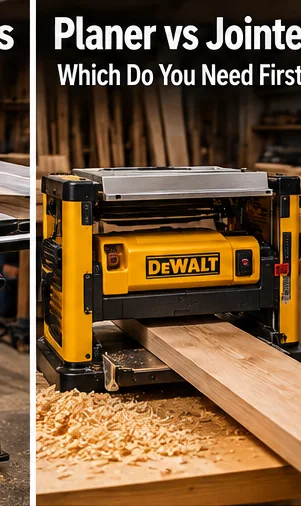
13-inch thickness planer
A planer handles every board in the project and can process much wider stock than a typical hobby jointer.
Best when: you want the broadest rough-lumber capability per square foot
Watch for: needs a sled or other method to flatten the first face
6-inch floor jointer
A jointer is incredibly fast at establishing references, but it is the first half of the milling process rather than the whole process.
Best when: you already own a planer or buy surfaced lumber that mainly needs straightening
Watch for: cannot produce final parallel thickness by itself
8-inch jointer + planer pair
The classic sequence remains efficient because each machine does one geometry job extremely well.
Best when: rough hardwood is a regular input and you have room for two machines
Watch for: highest cost and floor-space demand
What a planer can fake
With a rigid sled and shims, a planer can flatten a twisted or bowed face, then flip the board and make the opposite face parallel. It is slower than a jointer but gives a small shop a wide-board route.
What a jointer can fake
A jointer can flatten one face and square one edge, but it cannot reliably make a second face parallel to the first. Hand planes, a thickness sander or outsourced milling can fill that gap, but the machine itself does not.
Planers touch every board
Even if lumber arrives S2S, final project thickness often changes after acclimation or design. A planer therefore gets used on almost every rough-lumber project.
Jointers save setup time
Once rough-lumber volume increases, the sled workaround becomes tedious. A jointer can establish a flat reference in a few passes and move the board directly to the planer.
A table saw can straighten an edge after the first face is flat
With a suitable jig or track-guided first cut, you can delay the jointer purchase and still produce straight edges. That is another reason the planer often wins as the first dedicated milling machine.
Flat, straight and parallel are three different jobs
A jointer establishes one flat face and one straight, square reference edge. A thickness planer makes the opposite face parallel to the reference face while bringing the board to final thickness. A planer does not magically remove twist from a board that has no flat reference surface, and a jointer does not make two faces parallel. Understanding that division of labor is the key to buying milling machines in the right order.
There are workarounds: planer sleds can flatten a face, router sleds can flatten slabs, and a table saw can straighten some edges with jigs. Those techniques are useful in a small shop, but they trade machine cost for setup time. If rough lumber is part of your weekly workflow, dedicated milling machines eventually pay for themselves in repeatability.
Cutterhead choice changes noise and maintenance
Straight knives are inexpensive, widely available and can leave an excellent finish when sharp. Helical or segmented carbide heads spread the cut across many small inserts, tend to reduce tearout in difficult grain and let you rotate one damaged insert rather than replacing a whole knife. The trade is cost: a helical upgrade can be a substantial fraction of the machine's purchase price.
Do not buy a helical head because it is fashionable. Buy it if you mill figured hardwood, hate knife-setting, need lower perceived cutting noise, or plan to keep the machine long enough to recover the cost through insert rotation and reduced tearout.
Before checkout
- Machine fits the room with infeed and outfeed clearance
- Electrical circuit matches voltage and amperage requirements
- Dust port size matches the collection plan
- Guards, riving knife or cutter guards are present and usable
- Replacement blades, knives, inserts or belts are readily available
- Fence/table adjustments lock without visible deflection
- Mobile base or fixed placement is decided before assembly
- Noise and dust strategy are acceptable for the building
- Warranty and freight-return terms are understood
- First accessory budget includes blades/bits, dust adapters and work support
The hidden costs that belong in the machine budget
Cutters and consumables: the included blade, belt, knives or bits are often only a starting point. A premium ripping/crosscut blade, resaw blade, router bit or carbide inserts can materially change the machine. Put that cost in the first-day budget rather than judging the machine forever on the stock consumable.
Work support: long stock needs infeed/outfeed support; sheet goods need a breakdown surface; benchtop machines need a rigid stand or cabinet. Many disappointing machine purchases are really support-system problems.
Dust adapters and hose: machines rarely arrive with exactly the fitting your collector uses. Budget gates, reducers, short flex connections and, where appropriate, above-table or near-cutter pickup.
Electrical and mobility: a 230V circuit, mobile base or dedicated switch can change total installed cost significantly. A machine that blocks the shop when not in use has a real daily cost even if the invoice was cheap.
How to evaluate it in the first week
Before changing the factory setup aggressively, assemble the machine carefully, verify guards, check the table/fence/cutter relationships specified in the manual and make test cuts on known straight stock. Record the baseline. If a cut is wrong, diagnose one variable at a time: blade or cutter condition, fence alignment, table support, feed technique, dust buildup, then machine adjustment. Replacing several settings at once makes it harder to learn what the machine actually needed.
Keep the shipping material until the machine passes inspection. Large stationary tools are expensive to return by freight, and visible shipping damage should be documented before the crate or box disappears. Register the warranty, save the model/serial number and download the current manual; five years later those small administrative steps are surprisingly valuable.
Frequently asked questions
Can I use a planer without a jointer?
Yes. A planer sled can establish the first flat face, and other jigs can straighten an edge.
Can I use a jointer without a planer?
Yes for edge work and one-face flattening, but you still need another method to make the opposite face parallel at final thickness.
Which takes more shop space?
Benchtop planers store compactly; floor jointers require permanent floor length.
Which should a beginner buy first?
For a small shop intending to mill rough lumber, the planer is usually the more flexible first purchase.
Primary references
Affiliate disclosure: WoodShopMachines.com may earn from qualifying purchases through Amazon Associates and eBay Partner Network at no extra cost to you. Product links are shopping paths, not evidence that a larger or more expensive machine is automatically the right choice.