Affiliate disclosure: WoodShopMachines.com may earn from qualifying purchases through Amazon Associates and eBay Partner Network at no extra cost to you. Product links are shopping paths, not evidence that a larger or more expensive machine is automatically the right choice.
What each belt is
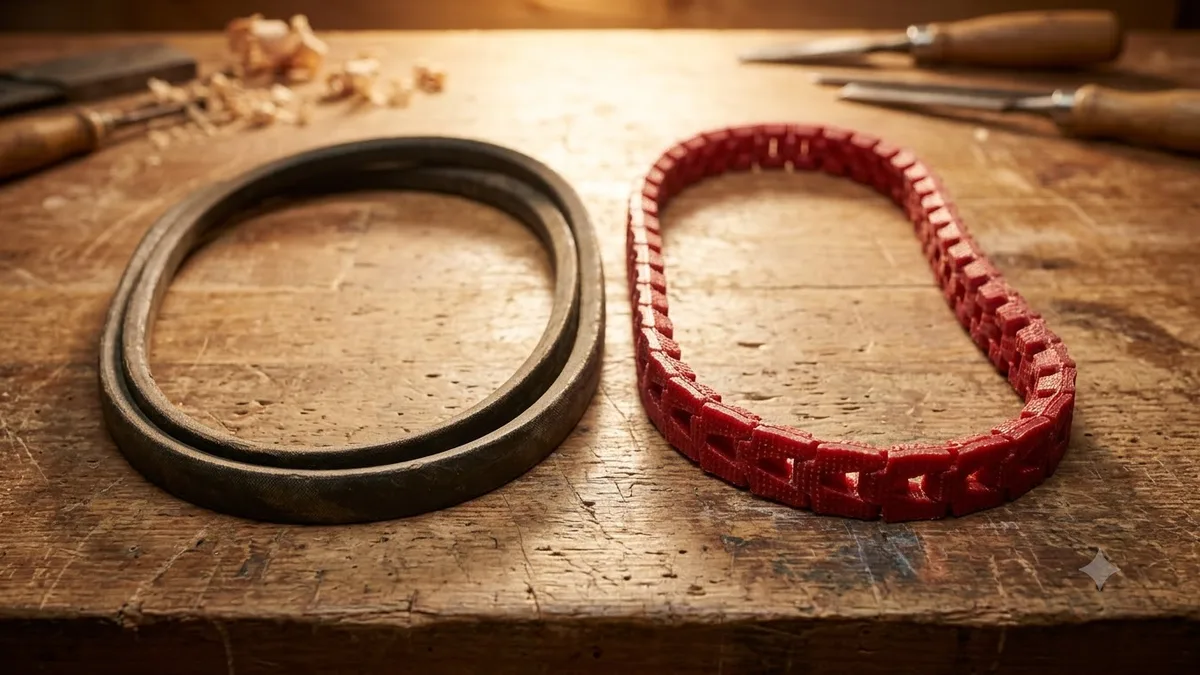
A standard V-belt is a continuous loop with a trapezoid cross-section that sits in the groove of a pulley. A general reference on V-belts describes solid belts as made of rubber or polymer throughout, or reinforced with embedded fibers such as polyester or aramid. The loop has to be slipped over the pulleys, which usually means loosening the motor mount or, on some machines, removing a pulley or other part to get the belt on.
A link V-belt is built from short links that join together. The same reference describes link belts as polyurethane and polyester composite links, held together either by the links themselves or with metal studs. It says they provide easy installation and better environmental resistance than rubber belts, and that you can shorten them by removing links.
Woodworking machines use belts for table saws, bandsaws, drill presses, planers, jointers and lathes. The belt is a wear item, and in a dusty shop it works in a harsh place. See the site's drive belts and pulleys pages for how each machine type uses them.
Side by side
| Point | Link belt | Standard solid V-belt |
|---|---|---|
| Fitting | Links join without sliding a loop over the pulleys, so it can be fitted in place | Loop must go over pulleys; may need parts moved |
| Length | Adjustable by adding or removing links | Fixed; you need the right size |
| Rated power and speed | Reference page says most link models match equivalent endless belts; check the maker's data | Sized by the machine maker |
| Vibration and noise | Often marketed as smooth running; confirm in the maker's literature | Smooth when sound, matched and aligned |
| Best for | Hard-to-reach drives, odd lengths, emergency repair | Machines built around the original belt, matched sets |
| Check first | Belt section, pulley diameter limits, maker's guidance | Size printed on the old belt or in the manual |
The table is a summary of what is commonly said, not a test. The vibration row is the one to be careful with. The reference page says belt drives in general run smoothly and damp vibration, but it makes no special claim for link belts. Any claim that a link belt cuts vibration on your machine is a maker's claim, so read the maker's literature and your machine manual. Vibration also comes from pulley eccentricity, misalignment and wrong tension, which no belt choice removes.
When a link belt makes sense
The strongest reason is access. On some machines, the drive is buried behind the motor, a cabinet panel or the arbor, and a continuous belt means taking things apart. A link belt can be assembled in place around the pulleys. That can turn a big teardown into a short job, which matters if the machine is your only table saw.
- Awkward drives: motors on a cabinet saw or bandsaw where the belt path is closed in.
- Unknown size: a machine with no label and no manual, where you can add links until the length is right and note it for later.
- A spare: some shops keep a length of link belt as a stopgap for a belt that breaks mid-project.
- Dusty or oily shops: the reference page credits link belts with better environmental resistance than rubber, but check the maker's data for your conditions.
Do not treat a link belt as a free upgrade. A joined belt has more parts than a loop, and its behavior depends on the pulley diameters, the belt section and how well the links are fitted. Use a belt section that fits your pulley grooves and follow the maker's instructions for joining and for any pulley size limits. If your machine manual names the belt or says not to substitute, follow it. The site's spare parts guide suggests what to keep on hand.
Adjustable link V-belt
Match the belt section to your pulleys, not just the old belt width, and read the maker's pulley-size guidance before ordering. Buy a length that gives you enough links to adjust.
When to stay with a solid V-belt
Choose a solid belt when the machine was designed around one and the manual gives the size. A tight drive, such as a saw arbor driven by a short belt on small pulleys, leaves little room for error. Where two or more belts run side by side on matching grooves, the reference page notes that several belts are often more economical than one larger belt, and in that case you need belts that are matched in length so they share load evenly. Replace the whole set at once.
A solid belt is also the right pick when you do not want a join in the drive. A link belt adds joints to inspect, and some machines are fussy about smoothness. If your machine has been quiet for years on the original belt and you can fit a new one without trouble, a like-for-like solid replacement is the least risky choice.
Keep a note of the belt size printed on the old belt. If it has worn off, the manual or the machine maker's parts diagram has it. For a machine without a manual, the operator manuals page and the machine model plates page help you find the information you need.
Replacement V-belt for your machine
Search the size on the old belt or in the manual, and buy a matched set where the drive uses more than one belt. Check the printed size against the old belt before ordering.
Fitting and tension, whichever you choose
Whatever belt you use, unplug the machine first. OSHA's page on controlling hazardous energy notes that an unexpected startup during servicing can cause serious injuries, including cuts and amputations. Take the plug out of the wall, not just the switch. Replace belt guards before you reconnect power.
Check the pulleys. Look for worn grooves, rust, chips and wobble, and make sure the two pulleys line up so the belt runs straight. A worn pulley will chew a new belt. Tension matters as well: the reference page says the ideal belt is the one with the lowest tension that does not slip under high loads, and that high tension adds stress to the belt and the bearings. Use the manual's method rather than tightening until the belt feels hard.
Run the machine briefly with no work and listen for slapping, squealing or a smell. A cold shop can make belts stiff, so the site's winter startup checklist includes belt checks, and the maintenance program guide fits belt inspection into a routine.
Frequently asked questions
Are link belts as strong as solid V-belts?
A general reference says most link models offer the same power and speed ratings as equivalent endless belts. Check the maker's data for your belt section and pulley sizes.
Do link belts reduce vibration?
Belt drives in general run smoothly, but vibration also comes from alignment, tension and pulley wear. Treat any special claim as the maker's claim and check the literature.
Can I use a link belt on any woodworking machine?
Not always. Follow your machine manual, and check the belt section and any pulley-size limits from the belt maker before substituting.
How do I size a replacement V-belt?
Use the size printed on the old belt, or the manual or parts diagram. For link belts, match the belt section and add links until the length is right.
Should I replace belts in pairs?
Where two belts run side by side, replace them together as a matched set so they share the load evenly.
Sources and verification
- Wikipedia: V-belt and Wikipedia: Belt (mechanical) (general references), for the descriptions of solid and link V-belts, easy installation, length adjustment, power ratings, the lowest-tension-that-does-not-slip idea and multiple-belt drives.
- OSHA: Control of hazardous energy, for the point that unexpected startup during servicing can cause serious injury.
No belt sizes, tensions, speed ratings or pulley limits are quoted. Vibration benefits are not claimed beyond what the maker's literature says. Confirm belt type, size and tension in your machine manual and the belt maker's instructions.