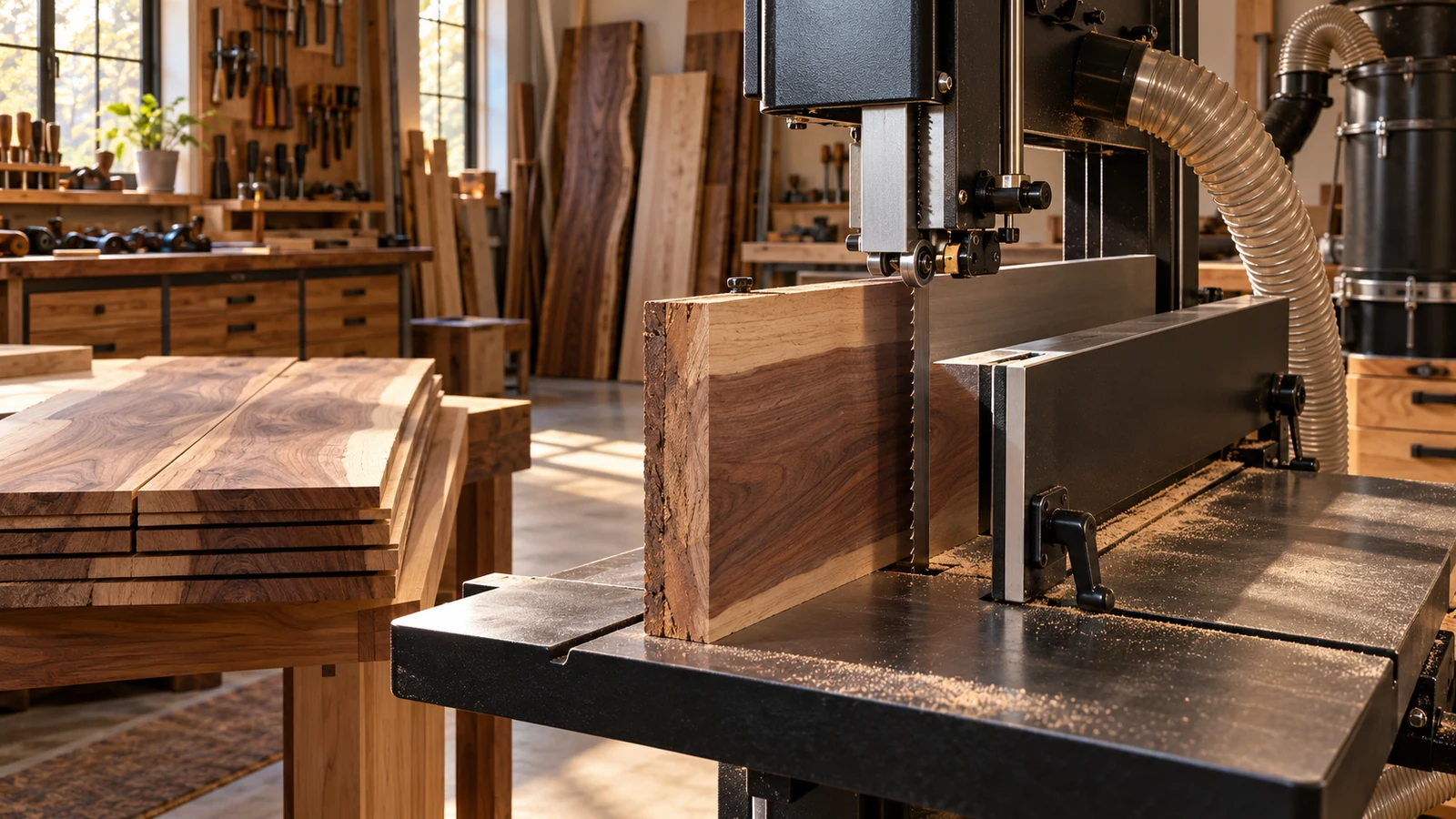
Bandsaw performance comes from the whole blade path: tires, tension, guides, blade geometry, fence and feed technique.
This guide looks specifically at benchtop vs 14-inch bandsaw: which one fits a small woodshop?. The goal is not to crown a permanent winner from a marketplace that changes every week. It is to show which specifications actually matter, how the part fits the rest of the shop, and what to verify before spending money.
Compare live listings for fit, included hardware and seller terms. Verify exact machine compatibility before ordering.
Start with the machine and the workpiece
Choose capacity around real workpieces. A smaller machine that fits the workflow may be more productive than a larger machine that blocks the shop.
Before browsing, write down the exact machine model, dimensions of the relevant interface, stock sizes you normally process, and the step that currently wastes time. That short note prevents the most common accessory mistake: buying an impressive part that solves a problem your shop does not have.
Three realistic shop scenarios
Small Craft Work
For small craft work, prioritize resaw height and blade availability. That pair connects the purchase to real work instead of to a feature list built for marketing.
Furniture Parts
For furniture parts, prioritize blade availability and table size. That pair connects the purchase to real work instead of to a feature list built for marketing.
Rough-Lumber Resawing
For rough-lumber resawing, prioritize table size and motor power. That pair connects the purchase to real work instead of to a feature list built for marketing.
Five buying criteria that actually change the decision
Resaw Height
Write down the actual requirement for resaw height before shopping. Compare it with the machine, stock size and surrounding setup. If the listing does not state the needed dimension, rating or interface clearly, treat that as uncertainty rather than compatibility.
Blade Availability
Write down the actual requirement for blade availability before shopping. Compare it with the machine, stock size and surrounding setup. If the listing does not state the needed dimension, rating or interface clearly, treat that as uncertainty rather than compatibility.
Table Size
Write down the actual requirement for table size before shopping. Compare it with the machine, stock size and surrounding setup. If the listing does not state the needed dimension, rating or interface clearly, treat that as uncertainty rather than compatibility.
Motor Power
Write down the actual requirement for motor power before shopping. Compare it with the machine, stock size and surrounding setup. If the listing does not state the needed dimension, rating or interface clearly, treat that as uncertainty rather than compatibility.
Floor Footprint
Write down the actual requirement for floor footprint before shopping. Compare it with the machine, stock size and surrounding setup. If the listing does not state the needed dimension, rating or interface clearly, treat that as uncertainty rather than compatibility.
Why the whole machine matters
A new accessory can shift the weak point somewhere else. A heavier fence can expose a flexible table. A better blade can expose loose guides. A larger hose can expose a poor hood. A mobile base can expose an uneven floor. Compare the before-and-after system instead of judging the product by itself.
Dust control belongs in the purchase
Wood dust is more than a cleanup nuisance. NIOSH describes inhalation, skin and eye exposure and documents respiratory and irritation risks. For accessories that change where chips leave the cutter, check whether they improve or obstruct capture at the source.
Small portable tools often pair well with higher-static-pressure vacuum systems. Larger stationary machines commonly benefit from larger ports and more airflow. Avoid assuming one hose diameter and one collector strategy is ideal for every tool.
Compare live listings for fit, included hardware and seller terms. Verify exact machine compatibility before ordering.
Used equipment and retrofit economics
Used woodworking equipment can be excellent value. Inspect table flatness, bearing noise, fence movement, guards, switch condition, damaged cords and missing proprietary parts. A bargain gets expensive quickly when a discontinued insert, bracket, motor control or bearing arrangement must be recreated.
For retrofits, price the accessory plus shipping, bearings, adapters, hardware, dust fittings and installation time. If that total approaches a newer machine that solves several issues at once, the retrofit is no longer automatically the economical choice.
Shop ergonomics after the upgrade
Imagine using the setup with a long board, dust hose, hearing protection and project parts stacked nearby. Can you reach controls? Does the accessory block a crank, fence rail, guard, depth stop or blade-change path? Can the machine move through its full adjustment range?
The best accessories disappear into the workflow. They make setup predictable, keep stock supported and reduce improvised workarounds. If a part requires a workaround every time it is used, the specification sheet has not translated into a better shop.
Price the complete working setup
Marketplace prices change too quickly to freeze a number into the article. Compare the delivered system instead: main accessory, mounting hardware, adapters, replacement consumables, electrical controls and dust fittings needed to use it on day one.
Also price the ownership path. Common bearings, belts, inserts, sleeves, blades and hose sizes are easier to keep working. Proprietary designs can be worthwhile when they solve a real problem, but know what the lock-in is before checkout.
Purchase worksheet
Decision worksheet: Resaw Height
Record what your current machine provides, what the project requires, and what would change after the purchase. Separate hard compatibility from preference. A mounting pattern, arbor size, voltage, hose diameter, cutterhead dimension or exact plate opening is a hard requirement. Cosmetics and convenience features usually are not.
Decision worksheet: Blade Availability
Record what your current machine provides, what the project requires, and what would change after the purchase. Separate hard compatibility from preference. A mounting pattern, arbor size, voltage, hose diameter, cutterhead dimension or exact plate opening is a hard requirement. Cosmetics and convenience features usually are not.
Decision worksheet: Table Size
Record what your current machine provides, what the project requires, and what would change after the purchase. Separate hard compatibility from preference. A mounting pattern, arbor size, voltage, hose diameter, cutterhead dimension or exact plate opening is a hard requirement. Cosmetics and convenience features usually are not.
Decision worksheet: Motor Power
Record what your current machine provides, what the project requires, and what would change after the purchase. Separate hard compatibility from preference. A mounting pattern, arbor size, voltage, hose diameter, cutterhead dimension or exact plate opening is a hard requirement. Cosmetics and convenience features usually are not.
Decision worksheet: Floor Footprint
Record what your current machine provides, what the project requires, and what would change after the purchase. Separate hard compatibility from preference. A mounting pattern, arbor size, voltage, hose diameter, cutterhead dimension or exact plate opening is a hard requirement. Cosmetics and convenience features usually are not.
Related WoodShopMachines guides
Frequently asked questions
What should I check first before buying benchtop vs 14-inch bandsaw: which one fits a small woodshop??
Start with resaw height. If that does not match the machine or work you own, the rest of the feature list is secondary.
Should I buy the largest or highest-capacity option?
Not automatically. Extra capacity can add weight, floor space, electrical demand or harder-to-source parts.
Is used woodworking equipment worth considering?
Often yes. Inspect alignment, bearings, tables, guards, electrical condition, missing proprietary parts and the cost of making the setup complete.
Can an accessory make an older machine safe?
Accessories can improve control or dust capture, but they do not replace the guards, procedures or limits specified by the machine manufacturer.
Why are dust collection recommendations different between tools?
Some tools favor high static pressure through small hoses while larger stationary machines need higher airflow through larger ports.
How should I compare marketplace listings?
Compare exact model numbers, dimensions, interfaces, included hardware and condition. Treat vague claims such as universal as something to verify.
Compare live listings for fit, included hardware and seller terms. Verify exact machine compatibility before ordering.
Technical references
Manufacturer pages are used for interface and machine-specific behavior, not as independent rankings.